
Measuring both torsional and translational displacements is crucial for structural design and analysis that exhibit three-dimensional (3D) responses. However, conventional methods need rectification to accurately measure the torsional displacement, including double integration from accelerometers and string length rectification from linear variable differential transformers (LVDTs). Vision-based methods have the potential for out-of-plane displacement monitoring using multiple perspectives. This study is the first shake table study measuring torsional displacements using a synchronized, multi-vision system that was calibrated using Structure-from-Motion (SfM) technique. An affordable, multi-vision approach is proposed to measure 3D dynamic structural displacements (e.g., torsional) with the effect of different synchronization methods studied. Finite element simulation on a 3D aluminum frame was conducted to design small-scale shake table tests, such as stiffness, mass, excitation, etc., to induce torsional displacements from unidirectional excitation. Fiducial markers and conventional sensors (e.g., accelerometers, potentiometers, etc.) were deployed on each story of the frame. A camera system was developed with four perspectives to monitor displacements with three in front and one on top of the shake table. The standard deviations of residuals between the proposed method and the baseline methods were 1.043 mm (in-plane), 0.304 mm (out-of-plane) and 0.050 (torsional) for the multi-vision system compared to conventional sensors. SfM was utilized to obtain the “ground truth” locations of key points during the camera calibration, and the performance of the SfM-based calibration is compared with (manual) ruler-based calibration. The dual-camera measurement results show improved accuracy with reduced peak-peak difference of 0.150 mm using audio-based synchronization over 0.967 mm using on-set triggering under upchirp excitation. Useful guidelines are also provided on the synchronization for affordable camera systems and on extrinsic camera calibration in practice.

Fig. 3. Schematics of (a) 3D FE model and (b) rotational displacements at different floor levels subjected to ground excitation (unit: mm).
Measuring structural vibrations help assess dynamic performances of civil structures and infrastructure. Although conventional displacement sensors have been widely adopted, they are contact-based methods which lack scalability. Recently, computer vision (CV) has been applied as a noncontact method to measure displacements. However, fast speed of structural vibration (e.g., in shake table tests) can inevitably cause motion blur that imposes challenges in all image-based object/feature detections, especially for normal portable cameras (without high-speed shutters). To address such issue, the study proposed a multi-vision, full-field sensing framework with affordable cameras using a novel global–local detection and deblurring (GLDD) module, which was designed with a generative adversarial network (GAN)-based deblurring model to enhance detection efficiency and accuracy by restoring blemished videos from multiple perspectives. Rauch-Tung-Striebel (RTS) smoother was studied for data fitting using incomplete observations caused due to severe motion-induced blurs. A shake table test was conducted on an aluminum frame with cameras and conventional sensors monitoring the structural vibrations. Fiducial markers were used to track the movement of the key locations on the structure. Results showed that the proposed method is satisfactory to monitor shake table tests when compared to conventional measurements with root-mean-square errors of 0.51–0.95 mm. The proposed deblurring module restored misdetection by 92.1 %, 50.6 %, and 25.2 % for mild-, medium-, and severe-level motion blurs, respectively. Smoother-based data fitting outperformed filter-based one when dealing with highly blemished images. The proposed monitoring system with GLDD and RTS smoother-based data fitting provides a robust measurement solution when dealing with motion blurs.

Fig. 1. Schematic views of (a) single-perspective setting with motion-induced blur on the sensor coordinate system (SCS), and (b) dual-perspective setting with the same structure feature observed by both cameras.
Ultra-high performance concrete (UHPC) has become increasingly popular in flexural design of structural members that require high performance. Although numerous experimental studies on passively reinforced UHPC flexural members exist, studies on monolithic members with larger cross sections are limited, and no information exists on full-field deformation measurements of such specimens. An experimental program consisting of 8 large-scale UHPC doubly-reinforced specimens with continuous longitudinal rebars was conducted under 4-point monotonic loading. The experimental objectives were to investigate rebar slip from one side of the specimens (longitudinal rebar with hooks only on one side), track crack propagation, and capture the full-field displacement and strain measurements during the loading. The noncontact measurements from the multi-camera computer vision system using 3D digital image correlation (3D-DIC) and AprilTag-based photogrammetry were compared with the physical (contact) displacement measurement system. Strain fields were obtained using dual-camera 3D-DIC and finite element (FE) analysis. Results showed a close agreement of the point-wise displacements obtained from the physical and computer vision monitoring systems. The asymmetric structural design caused slip that delayed rebar fracture and reduced the peak load below that predicted by sectional analysis. The measured global force-deflection curve was predicted by the FE model when using a calibrated bond-slip model between rebar and UHPC. Comparison between the full-field measurements using 3D-DIC and FE numerical models showed that the evolution of principal strains and cracking were consistent. 3D-DIC proved to be a promising measurement method for monitoring strain/displacement and calibrating/confirming FE model that conventional methods without full-field measurements cannot provide.

Fig. 12. G1S raw images (1st column) and overlayed vertical displacement distribution (2nd column); G3N raw images (3rd column) and overlayed vertical displacement distribution (4th column).
Municipal solid waste (MSW) landfills need regular monitoring to ensure proper operations and meet environmental protection requirements. One requirement is to monitor landfill gas emissions from the landfill cover while another requirement is to monitor the potential settlement and damage to MSW landfill covers. Current surveying methods on a landfill cover are time- and labor-intensive and have limited spatial coverage. Landfill operators and researchers have developed unmanned aerial vehicle (UAV)-based monitoring over recent years; however, UAV-based automatic detection of water ponding in landfills has not been studied. Hence, this study proposes a UAV-based approach to monitor landfills and detect water ponding issues on covers by using multimodal sensor fusion. Data acquired from sensors mounted on a UAV were combined, leading to the creation of a ponding index (PI). This index was used to detect potential ponding sites or areas of topographical depression. The proposed approach has been applied in a case study of a closed MSW landfill before and after Hurricane Ian. A comparison between the generated PI map and a manual survey revealed a satisfactory performance with an IoU score of 70.74%. Hence, the utilization of UAV-based data fusing and the developed PI offers efficient identification of potential ponding areas.
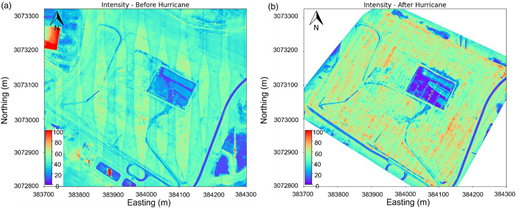
Figure 10. Reflective intensity maps extracted from the return laser pulses collected by LiDAR scanning (a) before the hurricane and (b) after the hurricane on the landfill (unit: %).
Small communities lack effective transit planning methods that integrate diverse forms of knowledge, foster collaboration, and envision better transit futures. To address this need, this paper presents a case study of a project conducted in Benton Harbor, Michigan. The case study demonstrates a collaborative and data-driven scenario planning process conducted for a small region, and evaluates it through a mixed-methods research design. Through the use of quantitative normative service scenarios and qualitative exploratory scenarios, the project generated financially and operationally feasible proposals that community leaders can implement in the future, and also fostered constructive dialogue among transit stakeholders. Survey data show that participants experienced high levels of learning, engaged in quality deliberation, and are generally optimistic about the potential for improved transit. The project’s approach can be replicated elsewhere through the use of five essential elements: a steering committee, stakeholder analysis, a series of engagement workshops, normative and exploratory scenarios, and interaction between data and modeling. Collaborative planning with scenarios can help the transportation field address the need to foster collaboration and epistemic inclusion in a changing world.

Fig. 3. The project scenario planning process featured extensive interaction between stakeholder workshop and engagement and the project’s data collection, modeling, and scenario-building activities.